Remote Patient Monitoring vs. Care Navigation in Home Health: Our findings

In the quest to reduce hospitalizations, enhance patient satisfaction, and better manage costs, home health owners and operators are increasingly recognizing the value of a virtual care strategy. Key to this approach are two transformative tools: Remote Patient Monitoring (RPM) and proactive clinician-led telephonic engagements, now referred to as Patient Relationship Management (PRM).

Both tools aim to enhance patient engagement and provide healthcare providers with critical insights between visits, helping them tackle complex challenges more effectively. The primary distinction in the home health space lies in the infrastructure and logistics required to operate a successful internal RPM program versus clinician-led telephonic engagements.

Before exploring further, let’s define RPM and PRM. We don’t aim to criticize RPM; as a technology vendor, we have supported over 150 providers in establishing successful programs with both RPM and PRM solutions. It’s important to recognize that this article primarily addresses the opportunities and challenges for home health providers serving patients without specific reimbursement methods, such as those under Medicare and Medicare Advantage.


Definitions


Remote Patient Monitoring (RPM)

  • According to CMS, RPM involves using digital technologies to collect health data from individuals in one location and electronically transmit it to healthcare providers in another location. This data can include vital signs, weight, blood pressure, blood sugar levels, pacemaker information, and more.

Patient Relationship Management (PRM)

  • This approach includes audio-only visits that utilize technology specifically designed for the unique demands of home health care. PRM assists care teams in gathering updates on patient perceptions, providing standard care information based on identified challenges, and capturing other valuable data that enables agencies to proactively address daily challenges. This includes coordinating upcoming visits, monitoring falls, ensuring medication adherence, and managing symptoms like shortness of breath.


Key Comparisons


Cost of Scalability

  • RPM: Traditional solutions often depend on physical equipment and internal staff for implementation and monitoring, which can be costly and limit scalability.
  • PRM: In contrast, PRM leverages innovative technology solutions combined with outsourced clinicians to engage patients, facilitating scalable and cost-effective expansion for home health agencies.

Equipment Logistics and Setup

  • RPM: Implementation challenges include the logistical and educational requirements for clinical teams, sometimes necessitating onsite visits for equipment setup.
  • PRM: A PRM program simplifies this by using proactive clinician-led virtual engagements, reducing the need for physical equipment and extensive patient education on technology use.

Staff Technical Support

  • RPM: Technical issues can frustrate patients and overwhelm home health staff who might lack the time or expertise to provide effective support.
  • PRM: PRM eliminates the need for physical equipment, simplifying technical support and enhancing patient satisfaction through reliable virtual interactions.

Success with Specific Patient Populations

  • RPM: Has shown remarkable success with specific groups, such as those with CHF or COPD, through targeted monitoring.
  • PRM: Offers a comprehensive solution that caters to a broader range of patients, potentially increasing the overall quality of care and identifying early intervention opportunities across diverse patient groups.

As the demand for virtual patient engagement grows, both RPM and PRM present valuable solutions. While RPM offers precise monitoring for specific patient populations, it faces challenges related to installation, education, and costs.

PRM stands out by offering a streamlined, scalable process capable of engaging most patients, reducing the need for in-person installations, and lowering costs related to equipment and staffing.

Ultimately, the choice between RPM and PRM will should depend on the specific goals and budget constraints of each home health agency as both would be highly recommended if financially feasible for your agency.
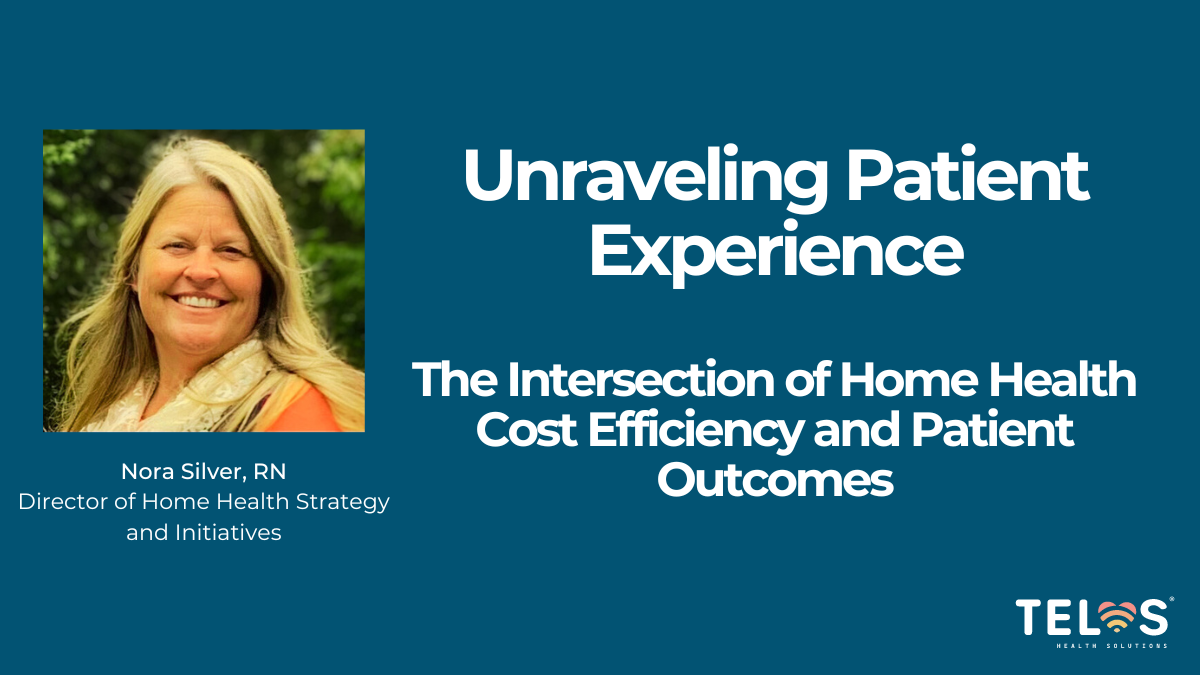
Unraveling Patient Experience: The Intersection of Cost Efficiency and Patient Outcomes

By Alice Nora Silver, RN, Director of Client Strategy and Initiatives at Telos Health Solutions.

“After decades navigating the intricate landscape of healthcare—with a special focus on 22 distinct years in Home Services—a revelation emerges,” says Nora Silver, RN. Amidst the complicated matrix of regulations and standards guiding care delivery, one aspect stands out—the patient experience. “It’s not just another box to tick; it’s our North Star,” she emphasizes, “leading the charge to redefine cost management and set unparalleled patient outcome standards.”

How does prioritizing the patient experience hold the key to unlocking the future success of Home Health?

Nora delves into the insights gathered since transitioning from her executive director role in a home health, hospice, and palliative care agency to becoming a key contributor to the inception of Telos’ Home Health Care-Navigation program.

1. The Rise of Quality Over Quantity

   As healthcare gravitates towards value-based models, there’s a pronounced shift. It’s not just about counting the frequency of in-home visits anymore; it’s about assessing their quality. This transition translates into more satisfied patients, invigorated healthcare professionals, and a sound financial framework for health agencies.

2. The Next Frontier: Virtual Care

   The digital age has redefined our patient connections. Integrating advanced engagement methods with virtual care platforms doesn’t just elevate the patient experience; it sets a new benchmark. And the added advantage? Our committed healthcare workforce remains efficient, ensuring care quality is uncompromised.

3. The Three T’s of Home Health: Trust, Timeliness, and Transparency

   Reflect on your personal interactions. Open communication is invaluable, particularly concerning health matters. By emphasizing transparency, healthcare providers can better understand their patients’ lives, ensuring care is not only timely but surpasses expectations. This open dialogue boosts patient engagement, leading to enhanced health outcomes.

4. A Happy Team Equates to Exceptional Care

Clinicians who feel appreciated, supported, and well-equipped deliver superior patient care. Emphasizing the importance of patient engagement can have a significant positive impact on the welfare and stability of care teams, as they can trust their employer is doing all it can to navigate changes being thrown their way while continuing to ensure patient-centric care is of the highest priority. All of this leads to increased patient engagement, reduced staff attrition, and consistently exceptional patient care.

Drawing upon my experiences, it’s evident that while the challenges in healthcare are vast, ranging from staffing concerns to cost control, the patient experience can be our beacon. This isn’t a mere trend; it’s a foundational shift in how we perceive Home Health’s future—a future where patients actively shape their health journey.

For a transformative change in Home Health, the patient experience must be central to our approach. It’s not just about refining services; it’s about fundamentally reshaping healthcare, envisioning a future where all stakeholders flourish. As we sail through the dynamic domain of Home Health—from medication reviews and disease management to care planning and discharge planning—patients should be active contributors, not just bystanders.


If you’re an agency keen on understanding how we optimize costs while ensuring top-tier patient outcomes, click this link to schedule a meeting or reach out to me directly at [email protected].

Bridging the Home Health Quality-vs-Cost Gap: The Power Patient Engagement as a Service

Home health agencies find themselves in a delicate balancing act, as conflicting objectives create additional challenges for care teams. On one hand, they must prioritize quality outcomes to keep patients out of the hospital and mitigate the potential negative financial impact of HHVBP. On the other hand, they must optimize visit utilization to reduce care delivery costs ahead of impending reimbursement reductions in 2023. This intricate dance places significant pressure on agency leaders to navigate these competing demands effectively, all while avoiding an increase in workforce turnover.

Partnering with a Virtual Patient Engagement as a Service provider offers a solution for leaders to bridge the gap between quality care and visit utilization for clinicians. This collaboration extends the reach of the care team by providing patients with valuable clinician-led engagements between in-person visits. By leveraging this forward-thinking approach, the risk of burnout and reluctance towards new initiatives or responsibilities can be mitigated, empowering care teams to deliver exceptional care with more information while maintaining a balanced workload.

What is Virtual Patient Engagement as a Service

Virtual Patient Engagement as a Service is a resource for home health agencies to stay connected with and support their patients through meaningful clinician-led engagements that take place between in-person visits. By proactively engaging patients through virtual means, agencies can enhance their level of patient engagement without placing excessive burden on their existing clinician workforce. Patients are reached through phone calls initiated from the agency’s office number, allowing for additional education, updates, and more to be provided, all of which are then reported back to their care teams for further action and monitoring.

Benefits of Working With a Patient Engagement as a Service Partner

Virtual patient engagement services offer more than just virtual clinician and patient interactions. Providers like Telos employ clinicians who work as an extension of the agency’s care teams to deploy innovative technology and processes that provide actionable insights and capture information from patient and electronic health records. Care teams receive valuable updates regarding the patient’s progress and priorities after each virtual engagement, enabling them to make proactive decisions and adjustments to the care plan. This personalized approach helps deliver effective care while minimizing the number of in-person visits required.

The Importance of Clinician-led Engagements Between Visits

Regular clinician-led engagements play a crucial role in helping home health patients achieve their care goals and prevent hospital readmissions, ultimately leading to improved quality outcomes. These interactions are essential in delivering high-quality care. However, reducing the number of in-person visits presents a challenge for care teams, considering their deep understanding of the positive impact that regular interactions have on patients. Moreover, keeping patients out of the hospital is the primary performance metric by which their performance is evaluated.

Empowering Care Teams and Fostering Trust

A Patient Engagement services partner who is truly invested in their clients’ success should focus on helping them recognize both the financial and patient-centric impact they are assisting in making through quality insights and actionable data. This ultimately provides peace of mind to care teams in the field. This collaborative effort should further foster an internal agency culture of trust and understanding, where clinicians feel confident in navigating the balance between optimizing visit utilization and delivering high-quality care. This confidence stems from knowing that their patients receive continuous support, even when they are not physically present. Such empowerment enables care teams to be open-minded about operational adjustments and fulfill their mission of providing high-quality care within limited resources.

Before Committing to a Long Term Contract,

Ensure It Effectively Solves The Problem

While a patient engagement-as-a-service partnership is a solution that can offer a lot of potential benefits in solving complex problems at the clinician and patient level, we advise all our clients to ensure they have the flexibility to exit the contract if the partnership doesn’t meet their expectations. Even better, consider asking the provider if they are willing to share the risk by establishing pre-determined metrics and goals. This approach ensures that both parties are committed to achieving the desired outcomes and can make adjustments if needed.

Screenshot 2023 07 20 at 2.32.18 AM

Click above to review our Mid-year client performance metrics or contact us to learn more about how we partner with home health care agencies through a data-driven yet patient-centric approach.