How an Automated 5-Day Check-In Caught a Medication Concern Before the Next Visit

The 7 days after admission is when small problems turn into big ones — especially around medications. Here’s a real example of how an automated post-admission check-in surfaced a patient concern and got it handled before the next clinician walked through the door.

The situation

  • An RN completed a Start of Care visit on 9/10.
  • On 9/15, the patient was automatically sent a 5-day post-admission check-in survey focused on their initial experience and medications.

What the patient did

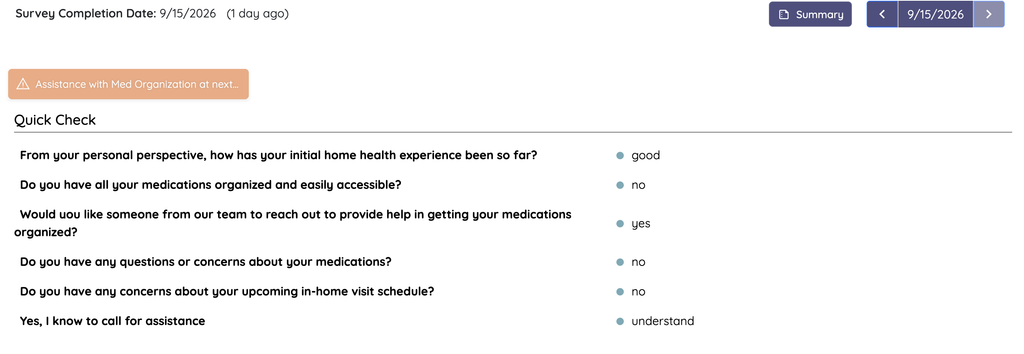
  • The patient completed the check-in survey and flagged a concern about managing their medications.

What the agency did

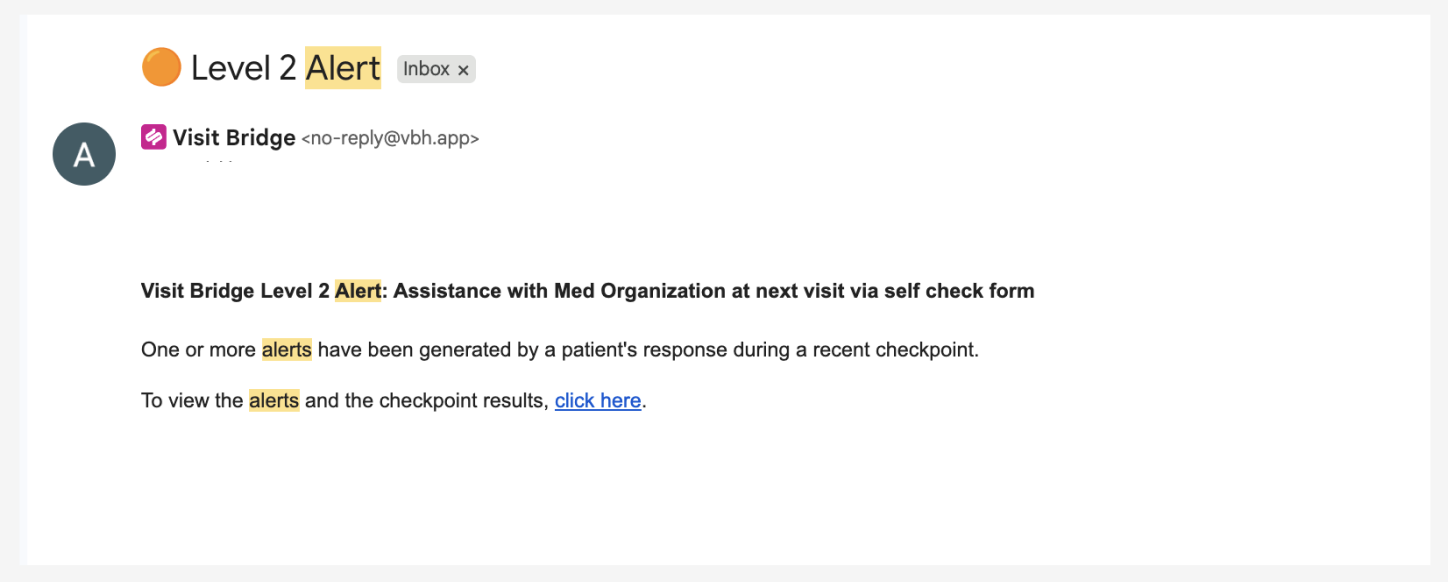
  • As soon as the survey was completed, Visit Bridge sent an automated email notification to the Clinical Manager.
image 3
  • The Clinical Manager clicked the link and reviewed the patient’s answers along with the alert.
image 4
  • She called the patient directly through the Visit Bridge Health platform from her office number to help in the short term.
  • She then looped in the next visiting clinician so they knew about the patient-stated concern before the 9/16 visit.
  • The field clinician walked into the 9/16 visit with a clear plastic bag for medication organization and additional medication administration education, ready to address the issue on the spot.

The takeaway

Most patients won’t call the office to say they’re confused about their medications. They’ll wait for the next visit — or worse, they’ll guess. An automated check-in gives them a simple way to speak up, gives the office a real-time alert, and gives the field clinician a head start. The problem gets solved on the very next visit instead of turning into a hospitalization.

How a Post-Discharge Follow-Up Turned Into a Wound Care Admission (and $2,100)

Discharge isn’t the end of the relationship — but for most agencies, it’s the end of the communication. Here’s a real example of how an automated post-discharge touchpoint brought a former patient back on service the moment they needed care again.

The situation

  • The patient was discharged from home health on 8/3.
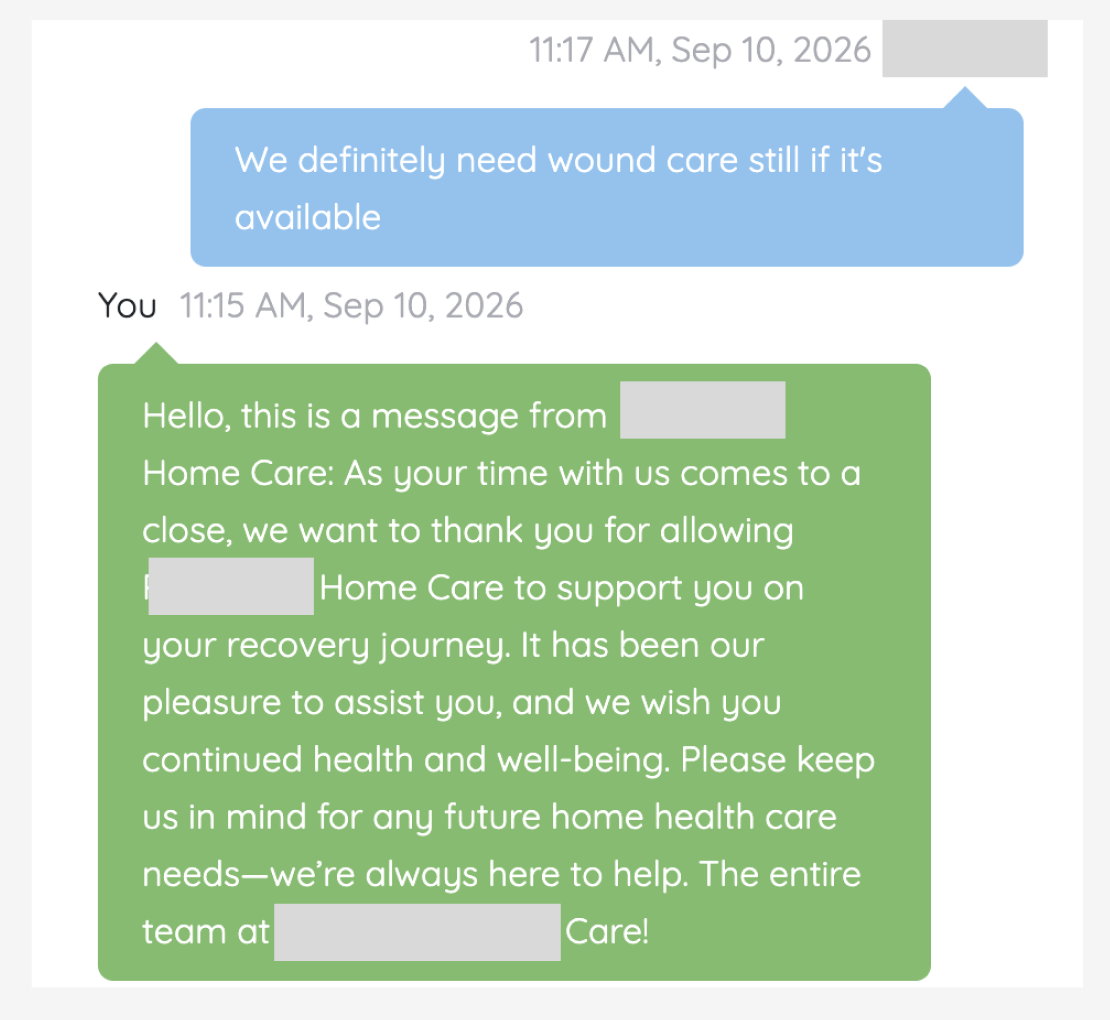
  • On 8/4, the agency set the patient up on an automated post-discharge engagement track through Visit Bridge Health — weekly touchpoints running through 9/10.

What the patient experienced

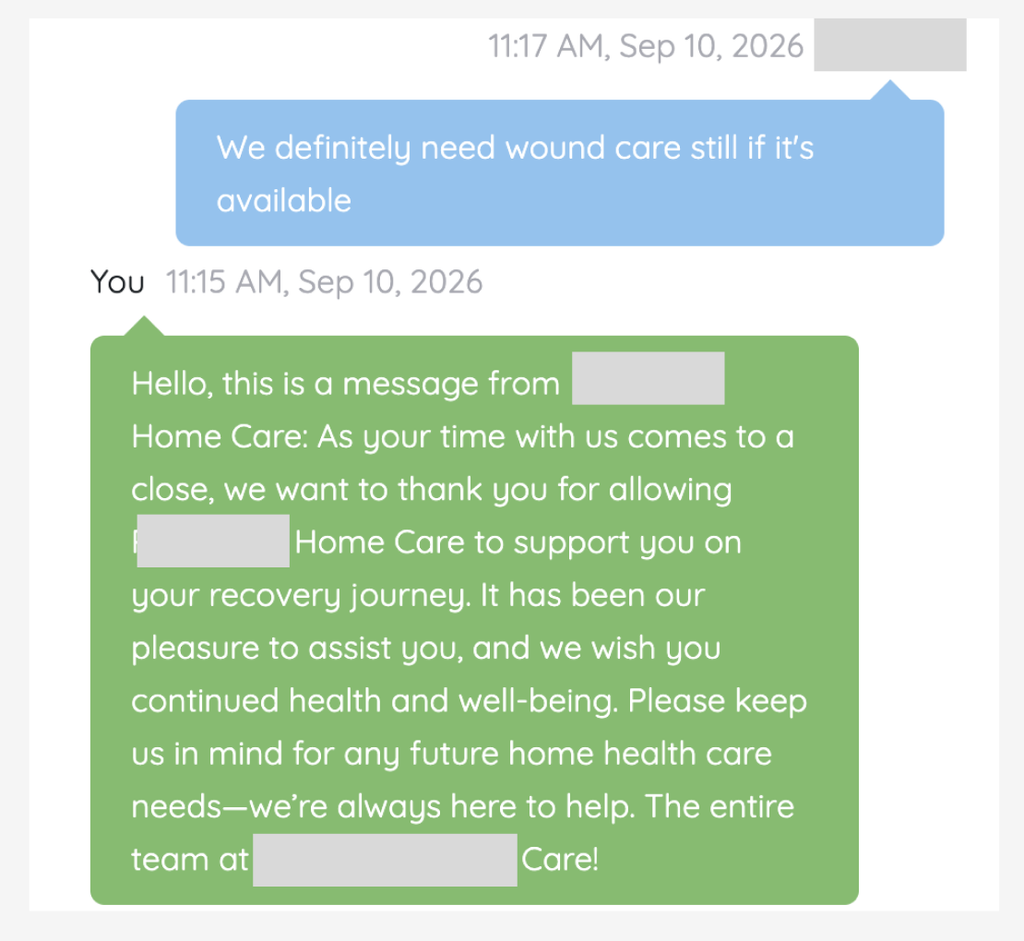
  • On 9/10, the patient received the final message in the track.
  • They replied that day, asking for help with wound care.
image 7

What the agency experienced

  • Visit Bridge sent an automated email to the Clinical Manager notifying them of a new patient message.
  • The Clinical Manager clicked the direct link, reviewed the message, and called the patient.
  • She coordinated a new Start of Care for 9/12 — two days after the patient reached out.

The math

  • Late, Community, Wound, Medium functional impairment, no comorbidity adjustment (HIPPS 3CB11)
  • Case-mix weight: 1.0848
  • CY 2026 national standardized 30-day base rate: $2,038.22
  • Unadjusted 30-day period payment: $2,038.22 × 1.0848 = about $2,211
  • If the same patient also earns a comorbidity adjustment, the same period pays more:
  • Low comorbidity (3CB21), weight 1.1416: about $2,327
  • High comorbidity (3CB31), weight 1.2838: about $2,617
  • For comparison, the other functional levels in the same late/community/wound bucket with no comorbidity: Low function (3CA11) is 1.0048, or about $2,048, and High function (3CC11) is 1.2201, or about $2,487.

ROI on one message: $2,038.22 using the national 30-day standard and assuming the patients length of stay was only 30 days.

The takeaway

Discharged patients don’t call the office when a new problem shows up. They call whoever is easiest to reach — a doctor, an ER, or another agency. Automated post-discharge engagement keeps your agency at the top of the list, so when the patient needs care again, the text thread is already open and the admission comes back to you.

How Automated Patient Engagement Turned a Great Care Experience Into HHCAHPS Feedback and a Google Review

Positive patient feedback is worth a lot to a home health agency in star ratings, referrals, and staff morale. The problem is that most of it never gets captured. Here’s a real example of how automated engagement did the capturing without anyone on the team lifting a finger.

The situation

  • The agency was struggling to get HHCAHPS surveys returned from patients.
  • An RN completed a Start of Care visit on 8/1.
  • That same day, the patient started receiving automated engagement messages and check-ins from the agency through Visit Bridge Health.
  • On 9/1, 30 days into the initial cert period, the patient became eligible for the HHCAHPS survey and the system automatically sent an educational text about the survey that day.

What the patient did

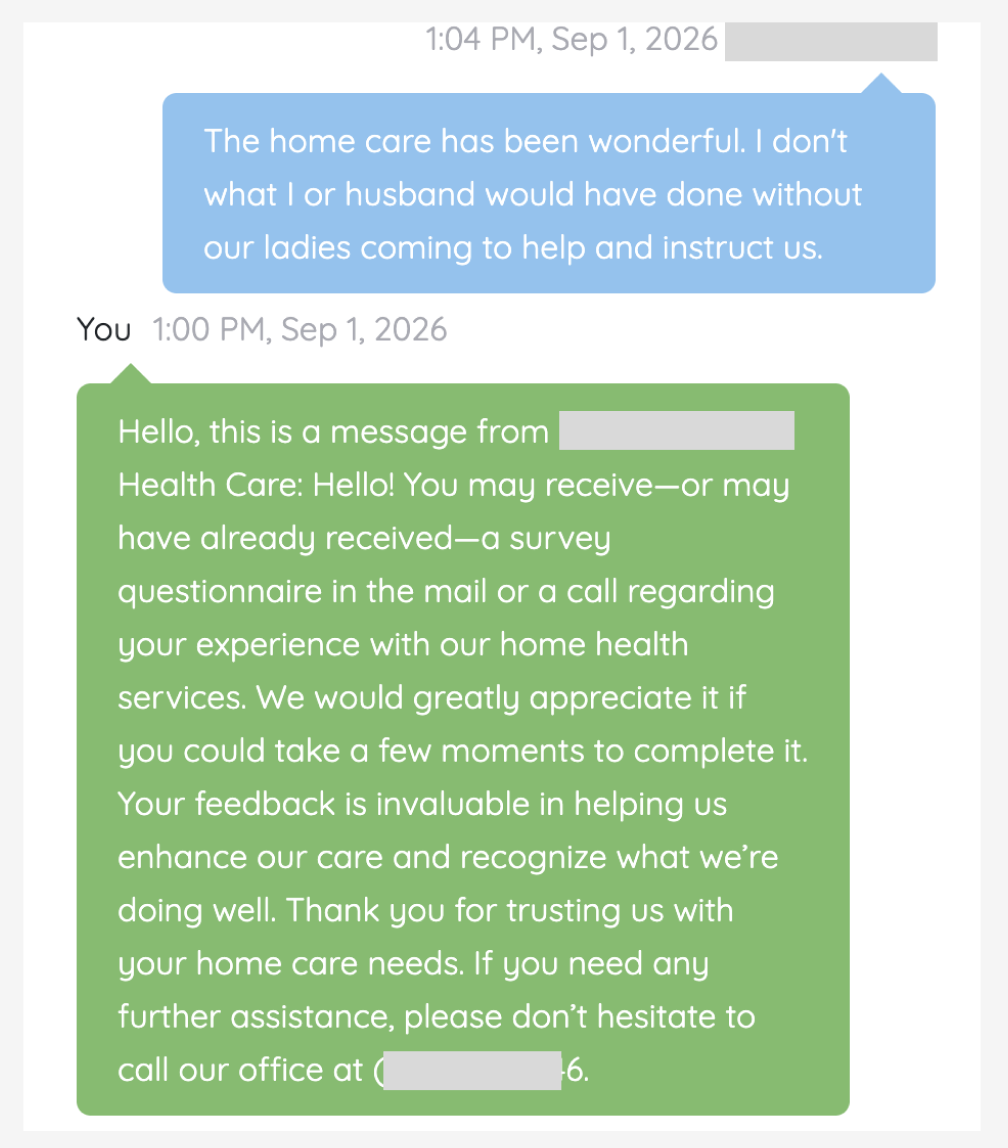
  • Four minutes after receiving the message, the patient replied with a message about their care experience.
image 1

What the agency did

  • Visit Bridge sent an automated email to the Clinical Director notifying them of a new patient message.
  • The Clinical Director clicked the direct link, reviewed the message in Visit Bridge, and identified the “gals” the patient mentioned by name.
  • Those clinicians were recognized at the next all-hands meeting.
  • On 9/2, an automated Google review request went to the patient and her husband, inviting them to share their experience to help others in the community.

The takeaway

Patients who are happy with their care rarely go out of their way to say so. Without a prompt, that feedback stays in the living room. Automated engagement gives patients an easy way to speak up, gives the agency a chance to recognize the clinicians who earned it, and turns a good experience into HHCAHPS responses and public reviews — all without anyone on the team having to remember to ask.

How Automated Patient Engagement Saved a Contracted Therapy Issue (and a $1,857 Episode)

Here’s a real example of what proactive patient engagement looks like in practice.

The situation

  • An RN completed a Start of Care visit on 8/29.
  • The patient needed Physical Therapy, and it was discussed at the SOC visit.
  • The agency ordered a therapy eval through a contracted therapy company.
  • The therapy company assigned a PT — who was slow to reach out.

What the patient did

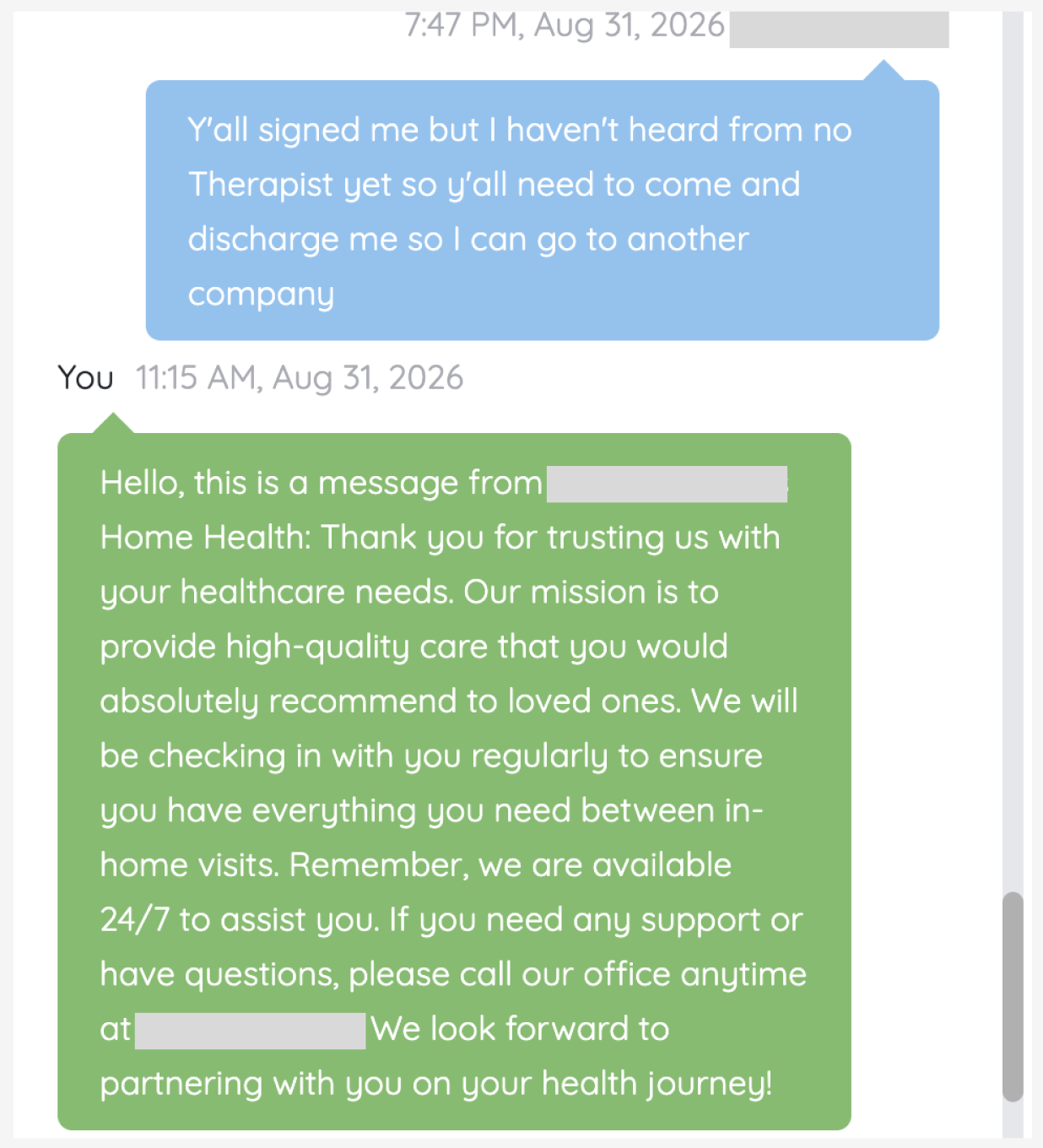
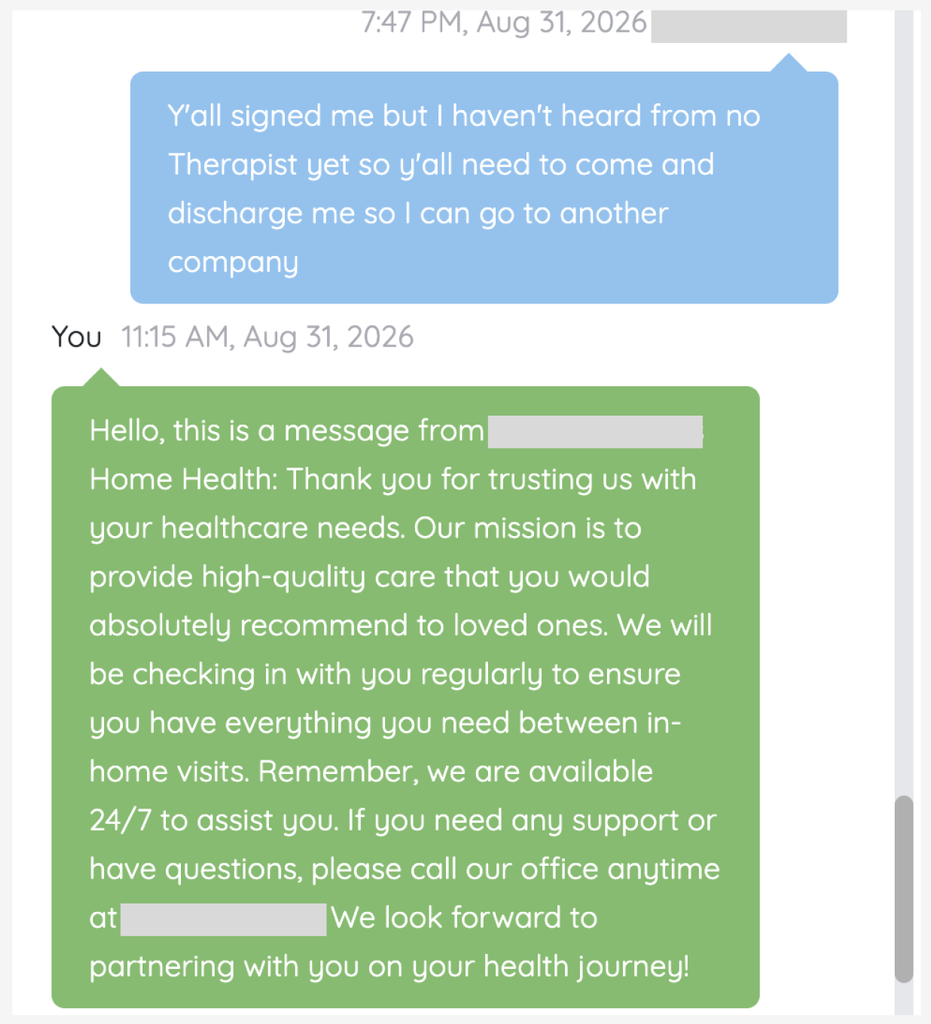
  • The day after admission, the agency’s automated welcome message was sent to the patient at 11:15 AM.
  • Eight hours later, the patient replied. They hadn’t heard from a therapist yet and wanted to be discharged so another agency with therapy could take over.
image

What the agency did

  • The Clinical Manager received an automated email notification about the new patient message.
  • The Clinical Manager clicked the direct link, reviewed the incoming message in Visit Bridge, and called the patient through the platform.
  • They then coordinated with the nurse and the contracted PT company and resolved the issue before anyone showed up at the door.
  • The patient stayed with the agency. No discharge, no lost episode.

The math

  • Medicare average 30-day episode: $2,034
  • Medicare LUPA threshold: 2 visits
  • Visits completed if the patient had discharged: 1 (a LUPA)
  • National average RN LUPA payment: $176.96

ROI on one message: $1,857.04 — and that assumes the patient only stayed 30 days.

The takeaway

Most patients don’t know what to do to be proactive about the care they need. Too often, an agency only catches the problem after a molehill has turned into a mountain. The real power of automated patient engagement isn’t just the content of the message — it’s the window of communication it opens with patients, without anyone lifting a finger.

Home Health patient engagement: The complete guide to improving outcomes & satisfaction

Effective home health patient engagement reduces avoidable problems between visits, improves patient experience scores, and gives clinicians timely, actionable information.

  • Two-way, messaging-first communication that works on patients’ existing phones (no new app).
  • HIPAA‑compliant surveys and automated alerts that surface risks and document outreach.
  • Analytics and response tracking that prioritize visits, reduce readmission risk, and protect your public reputation.

Schedule a demo to see how automated SMS and HIPAA-compliant messaging fit into your agency’s workflow.

The role of technology in patient engagement

Technology should extend clinicians’ reach between visits without adding complex workflows. Two-way texting, automated check‑ins, and HIPAA‑compliant surveys provide low-friction touchpoints that keep patients safer and clinicians informed.

Why these tools matter:

  • Two-way texting enables simple symptom checks, appointment confirmations, and brief care instructions directly on a patient’s phone—faster than voicemail and more accessible than portals.

  • HIPAA‑compliant surveys collect standardized patient experience and safety data, while retaining secure audit trails and consents required for regulated programs.

  • Real-time analytics and alerts flag medication issues, fall risk, or missed visits so clinicians can intervene proactively.

Key strategies to enhance engagement

1. Implement structured between‑visit check‑ins

Send brief, scheduled SMS check‑ins focused on pain, medication adherence, and wound status. Keep questions short, use clear response options (e.g., 1 = OK, 2 = Needs attention), and escalate automatically when responses indicate concern.

2. Use two‑way messaging for rapid triage

Enable clinicians and care coordinators to exchange short messages with patients and caregivers for clarification before home visits. Two‑way texting reduces missed problems and improves visit preparedness without forcing an app install.

3. Deploy HIPAA‑compliant surveys for patient experience

Automate patient experience surveys after episodes of care or at regular intervals to track measures used in public reporting and value‑based programs. Tie survey results to clinician dashboards so issues are remediated quickly.

4. Maintain an emergency mass‑text capability

For urgent events (severe weather, recall, public health alerts), an emergency mass‑text can reach your patient population rapidly. Combine this with response tracking to document outreach and compliance.

5. Automate review and reputation workflows

When appropriate, follow satisfied patient responses with an automated, HIPAA‑safe request for an online review—improving your public profile while preserving privacy.

Benefits and outcomes of effective engagement

When deployed thoughtfully, messaging-first engagement supports the outcomes agency leaders care about:

  • Reduced avoidable hospital use: Early symptom detection and quick clinician follow‑up can reduce escalation that leads to ED visits or readmissions. Home Health Value‑Based Purchasing (HHVBP) increasingly ties payment to outcomes and improvement efforts. (cms.gov)

  • Improved patient experience scores: Home health patient experience (Home Health Care CAHPS) is publicly reported and influences referrals, payer relationships, and value‑based program performance. Systematic experience collection helps agencies respond to concerns before they affect scores. (cms.gov)

  • Secure, auditable communication: Messaging platforms that meet HIPAA administrative and technical safeguards (including Business Associate Agreements and secure data handling) let agencies communicate by text while managing regulatory risk. See HHS guidance on HIPAA responsibilities for covered entities and business associates. (hhs.gov)

  • Measurable engagement gains: A body of evidence shows SMS‑based interventions improve appointment attendance, adherence, and some prevention outcomes—making text messaging a practical modality for between‑visit engagement. Use published reviews to design evidence‑based message cadence and content. (journals.sagepub.com)

Implementation checklist for agency leaders

Start small, measure fast, and scale what works:

  • Choose a messaging vendor that offers a HIPAA Business Associate Agreement, audit logs, encryption, and configurable consent flows.

  • Map 3–5 high‑value use cases (e.g., medication check, wound photo follow‑up, post‑hospital discharge check‑in) and pilot for 4–8 weeks.

  • Define escalation rules: which responses auto‑alert clinicians, which generate a nurse call, and which are documented for quality reporting.

  • Train clinicians on plain‑language message templates and consent scripts; emphasize no new app so patients can use their phones easily.

  • Monitor engagement metrics and tie results to quality programs (HHVBP, HH QRP) and patient experience reporting. (cms.gov)

Privacy and compliance brief

Texting that touches protected health information must meet HIPAA Privacy and Security Rule requirements. Secure platforms, clear patient consent, and documented safeguards (encryption, access controls, retention policies) reduce regulatory risk—while still allowing the convenience of SMS for patients who opt in. Refer to HHS resources and your compliance team when building policies. (hhs.gov)

Conclusion — why engagement matters now

Home health patient engagement is no longer optional: value‑based payment, public experience reporting, and workforce limits make efficient between‑visit communication essential. A messaging‑first approach—two‑way texting, HIPAA‑compliant surveys, emergency mass‑texting, and analytics—lets agencies scale touchpoints without adding staff and improves the information clinicians need to deliver safer, higher‑quality care.

Helping Care‑at‑Home build trust with patients and clinicians, turn insights into opportunity, and strengthen public brand reputation.

Next step: Schedule a demo to see a HIPAA‑compliant messaging workflow for medication checks, post‑discharge follow‑up, and emergency alerts. What If Your Agency Had More Touch‑points Without More Work?

Selected sources: CMS Home Health Value‑Based Purchasing; Home Health Care CAHPS (CMS); HHS summary of HIPAA privacy and security obligations; umbrella reviews on the role of SMS in healthcare; CDC/HHS guidance on texting for public health communication. (cms.gov)

5 Areas Your Home Health Agency May Want to Review to Enhance User Experience in 2024

By Nora Silver, RN

The Home Health industry can be an overwhelming environment even for industry veterans. The sheer number of laws, rules, regulations, and standards that have to be met often cloud the view of the big picture. As if all the governance was not enough to keep industry leaders up at night, additionally there are STAR ratings, HHVBP, and Surveys that serve as the public report card of agency performance. These concerns are rounded out with financial challenges and staffing crises, creating the turbulent storm many agencies find themselves in.

Over the past 16 months, I’ve been able to step back and truly reflect on my 23 years of experience of living it at the agency level and be a part of building something that solved so many of the challenges our agency faced day in and out.

I’ve found various parallels across the high-performing agencies we work with at Telos Health Solutions, but the more I think about it, the more one universal aspect stands out: providers who set a unified goal around the end-user experience outperform the rest of the pack.

With that said, the end-user experience looks different for the different stakeholders, but there is a common denominator in which I feel all stakeholders desire. So, for owners/operators trying to rally their teams or putting new initiatives into place in 2024, I hope these 6 steps are helpful!

1: Define the Ultimate Goal

The ultimate goal of Home Health can be distilled into one simple idea: prevent unplanned hospital use and keep the patient at home. 

2: Understand Stakeholder Influence

Understanding stakeholder influence is vital to effectively navigate from point A to point B in the most efficient manner. All too often in the home health arena, we as leaders can get caught up in the data points, which can lead us to lose sight of the levers that need to be pushed at the right time to achieve the desired outcome. For example, if we constantly educate our teams on the importance of outcomes from a payer perspective without providing insights or updates on how we, as leaders, are making changes to improve the clinical team’s day-to-day experience to assist them in achieving their set goals, it can often be lost on deaf ears.

3. Manage Risks Effectively

Identify potential obstacles to achieving the goal, including stakeholder engagement, injury prevention, safe medication use, symptom management, early detection of decline, infection control, maintaining functional stability, and ensuring adequate in-home support. Utilize the Medicare Conditions of Participation (CoPs) as a solid foundation for risk management and compliance. CoPs, such as patient rights, comprehensive assessment, and care planning and coordination, address patient-specific readmission risks. Additionally, consider integrating external strategies like virtual patient engagement programs, standardized staff education, and efficient OASIS/Plan of Care and coding practices to enhance success. 

4. Build Momentum by Focusing on Small Wins

As clinicians, we’re typically set in our ways, and many of us abhor change. Combine that with the significant changes that have occurred in the industry over the last five years, and it’s become more challenging than ever to see the impact made through new initiatives. However, sometimes the only way to succeed is to be willing to think outside the box and embrace change. Instead of solely focusing on the end goal, which can often change, I’d recommend finding ways to shift your focus toward achieving small wins. A 1% improvement each day equates to a 36x improvement over the course of a year, so finding ways to set and accomplish small wins can go a long way in the grand scheme of things for a few reasons:

  1. It provides leaders with a means to showcase and praise teams for their accomplishments on a routine basis.
  2. It reduces friction when you need to adjust big-picture goals due to industry or market conditions.

5. Establish a Universal Scoreboard 

Identify success indicators through STAR ratings and HHVBP, which combine OASIS data, claims data, and patient experience data, providing insights on performance from different perspectives. Use these public scores along with others provided by your solution vendors to pinpoint areas of strengths and weaknesses in achieving the ultimate goal of keeping patients at home. Furthermore, a scoreboard serves as a unified reference point for assessing your progress collectively as a team, enabling you to identify and address both technical (software/systems) and non-technical (process/communication) user experience roadblocks.

I truly believe that by focusing on the end-user experience and setting goals that strategically take stakeholder influence into account, home health agencies can navigate these challenges and thrive, ultimately providing better care and support for those who need it most in 2024.

Navigating HCAHPS: From Patient Experience to Financial Success in Home Health Care

In the constantly changing home health landscape, understanding the nuances of the Home Health Care Consumer Assessment of Healthcare Providers and Systems (HCAHPS) scores is crucial for home health agencies. At the heart of this journey lies the differentiation between ‘patient experience’ and ‘patient satisfaction’, two factors that significantly influence the value-based purchasing (VBP) model.

Distinguishing Patient Experience from Patient Satisfaction

As explained by the Agency for Healthcare Quality and Research:

“The terms patient satisfaction and patient experience are often used interchangeably, but they are not the same thing. To assess patient experience, one must find out from patients whether something that should happen in a healthcare setting (such as clear communication with a provider) actually happened or how often it happened.

Satisfaction, on the other hand, is about whether a patient’s expectations about a health encounter were met. Two people who receive the exact same care, but who have different expectations for how that care is supposed to be delivered, can give different satisfaction ratings because of their different expectations.”

Below, we’ve selected a few HCAHPS survey questions to provide perspective on these two distinctions.

Q3: “Were you advised on how to safely organize your home when you began your home health care journey with this agency?”

Q4: “At the onset of your home health care, were you consulted about all the medications you were taking, both prescription and over-the-counter?”

Such questions focus on tangible interactions, spotlighting the patient’s experience. Conversely:

Q20: “On a scale from 0 to 10, where 10 represents the best possible care, how would you rate this agency’s home health providers?”

Q25: “Would you recommend this agency to family or friends seeking home health care?”

These questions aim to gauge the overall emotional response and the satisfaction levels patients have towards their care.

Here is a link to the HHCAHPS survey. Take a look and determine if you agree with our viewpoint that 16 out of the 19 questions, or 84% of the survey questions influencing an agency’s HHVBP scores, prompt patients to recall specific aspects of their home health care experience rather than measure their level of satisfaction.

The Financial Implications with Home Health Value Based-Purchasing (HHVBP)

In 2025, HCAHPS scores may influence up to 30% of the the home health value-based purchasing financial outcome. In the intensely competitive industry, these changes could have profound impacts on agencies Medicare reimbursement adjustments by up to 5%, either positively or negatively.

Implementation Change to Drive Success

Comprehensive Understanding of HCAHPS:  Surveys indicate that while many home health executives understand the importance of HCAHPS, they believe only a few point-of-care clinicians genuinely grasp the HCAHPS survey. It’s vital to ensure your team fully comprehends each question and adjusts care strategies accordingly.

Revised Engagement Paradigms: Aim for patient engagements that are both meaningful and memorable. When patients recall experiences, the likelihood of them answering favorablely significantly increases.

Education & Skill Enhancement:  Emphasizing the significance of HCAHPS scores to your staff is crucial to ensure they understand the substantial impact that patient experience has on the HCAHPS survey questions.

Integrating Proactive Feedback Mechanisms (Weekly calls as an example):  Implementing a continuous feedback system that fosters ongoing patient engagement between in-home visits is essential. This system can involve activities like conducting weekly calls to gather updates, delivering standardized education regarding medication routines, emphasizing the significance of home safety, discussing upcoming schedules, and more. Such proactive measures are instrumental in averting the escalation of minor issues into significant challenges.

Upcoming ACHC Masterclass Webinar: Elevate Your Agency – Mastering HHVBP: Best Practices for Enhancing Quality of Care

For those eager to stay ahead and grasp impending changes, J’non Griffin, RN, SVP of Coding at SimiTree, will present a three-part ACHC masterclass webinar on HHVBP in September.

OASIS, Patient Engagement, and Expanded HHVBP Model – September 14, 2024

Reducing Hospitalizations with Care Management Protocols – September 21, 2024

Improving Patient Case Management to Increase HHCAHPS Scores – September 28, 2023

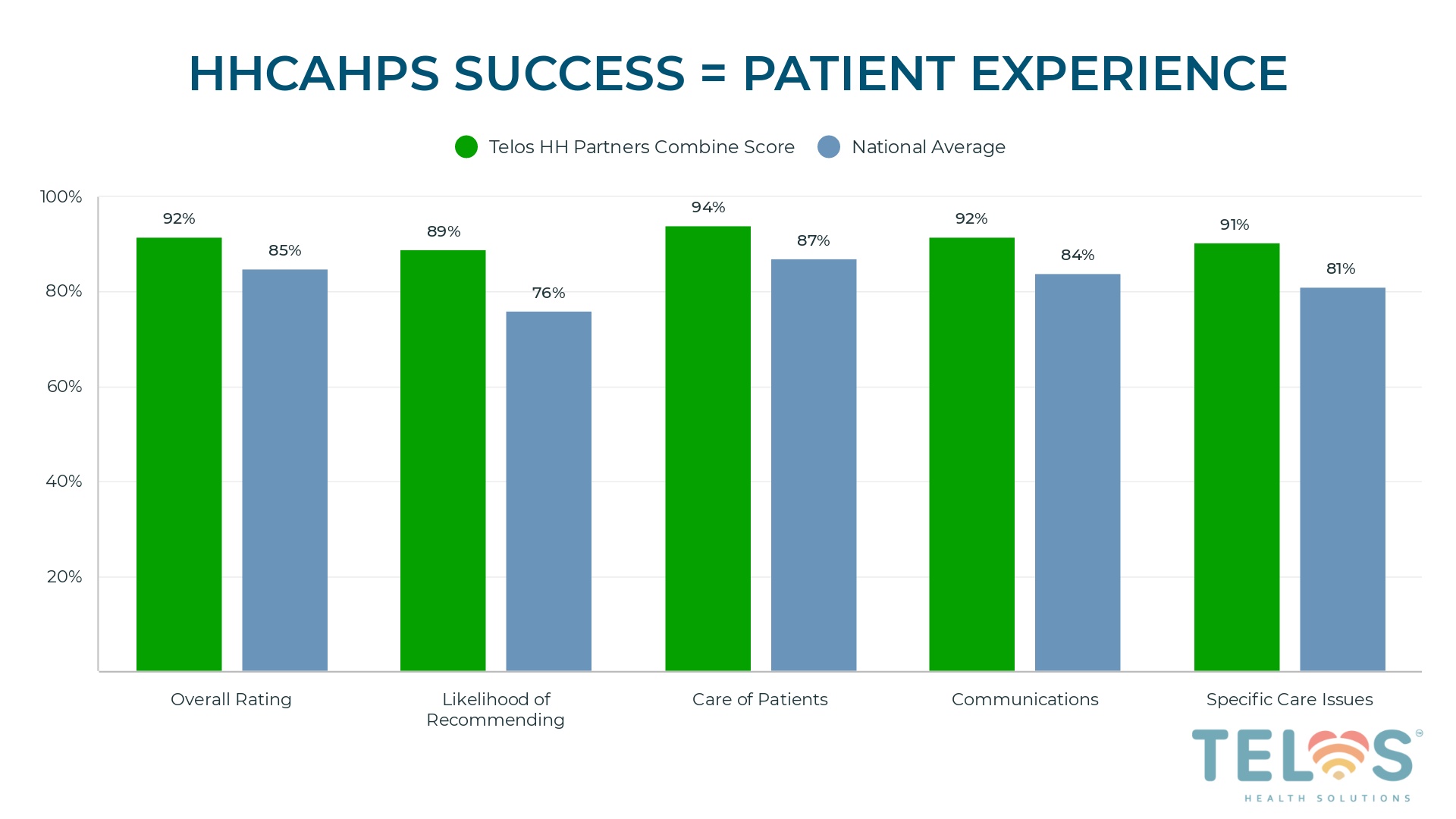
During the final session on September 28, 2023, Matthew Mulski, Co-founder of Telos Health, will join her to delve into the intricacies of HCAHPS questions and unpack the playbook Telos has used to assist its home health partners in outperforming the national average across all 5 HCAHPS measures, while also achieving a 4.61% hospitalization rate among patients actively engaged in their partners’ home health care navigation program (approximately 70% of patients receiving care from their home health partners as of mid-year 2023).