How a Routine Welcome Message Guided Two Therapy Visits the Family Didn’t Know to Ask About

How a Routine Welcome Message Guided Therapy Evaluation Coordination


Not every engagement assist shows up cleanly in the math. Sometimes the win is simpler: a family member who doesn’t know the clinical terms still knows something’s needed and automated engagement gives them a way to say so.

The situation

An RN completed a Start of Care visit on Friday, 11/6.

The patient’s son was in town, staying with his family member after a hospital discharge to home.

What the son did

On Saturday morning, 11/9, the agency’s automated welcome message went out — timed to the Friday SOC.

On Monday, the son responded first thing in morning, asking about getting “additional preliminary visits” scheduled. He wasn’t using clinical terms, but the message made clear he was asking about the other visits that were mentioned by the nurse — the visiting nurse had told the family the patient needed PT and OT evals.

PMwA5BQAAAAAElFTkSuQmCC

What the agency did

The office saw the message and coordinated directly with the contracted PT and OT companies and the patient to ensure eval visits were scheduled and communication was clear.

The takeaway

ROI is hard to put a clean number on in a case like this as there’s no visit or episode to calculate against. But the value is still real: a family member who didn’t know exactly what to ask for still had a way to flag what the patient needed, and the office acted on it quickly. That’s the kind of engagement that keeps hospitalizations down and shows up in HHCAHPS and Value-Based Purchasing scores over time, even when it doesn’t show up in a single dollar figure.

How an Automated 5-Day Check-In Caught a Medication Concern Before the Next Visit

The 7 days after admission is when small problems turn into big ones — especially around medications. Here’s a real example of how an automated post-admission check-in surfaced a patient concern and got it handled before the next clinician walked through the door.

The situation

  • An RN completed a Start of Care visit on 9/10.
  • On 9/15, the patient was automatically sent a 5-day post-admission check-in survey focused on their initial experience and medications.

What the patient did

  • The patient completed the check-in survey and flagged a concern about managing their medications.

What the agency did

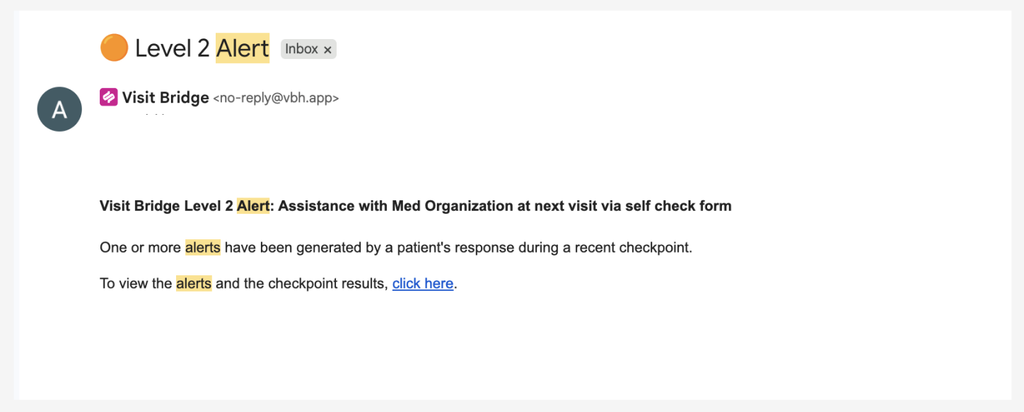
  • As soon as the survey was completed, Visit Bridge sent an automated email notification to the Clinical Manager.
image 3
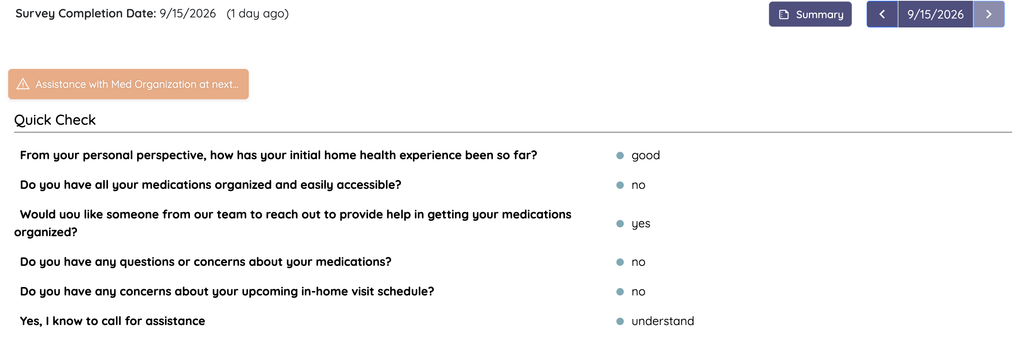
  • The Clinical Manager clicked the link and reviewed the patient’s answers along with the alert.
image 4
  • She called the patient directly through the Visit Bridge Health platform from her office number to help in the short term.
  • She then looped in the next visiting clinician so they knew about the patient-stated concern before the 9/16 visit.
  • The field clinician walked into the 9/16 visit with a clear plastic bag for medication organization and additional medication administration education, ready to address the issue on the spot.

The takeaway

Most patients won’t call the office to say they’re confused about their medications. They’ll wait for the next visit — or worse, they’ll guess. An automated check-in gives them a simple way to speak up, gives the office a real-time alert, and gives the field clinician a head start. The problem gets solved on the very next visit instead of turning into a hospitalization.

How a Post-Discharge Follow-Up Turned Into a Wound Care Admission (and $2,100)

Discharge isn’t the end of the relationship — but for most agencies, it’s the end of the communication. Here’s a real example of how an automated post-discharge touchpoint brought a former patient back on service the moment they needed care again.

The situation

  • The patient was discharged from home health on 8/3.
  • On 8/4, the agency set the patient up on an automated post-discharge engagement track through Visit Bridge Health — weekly touchpoints running through 9/10.

What the patient experienced

  • On 9/10, the patient received the final message in the track.
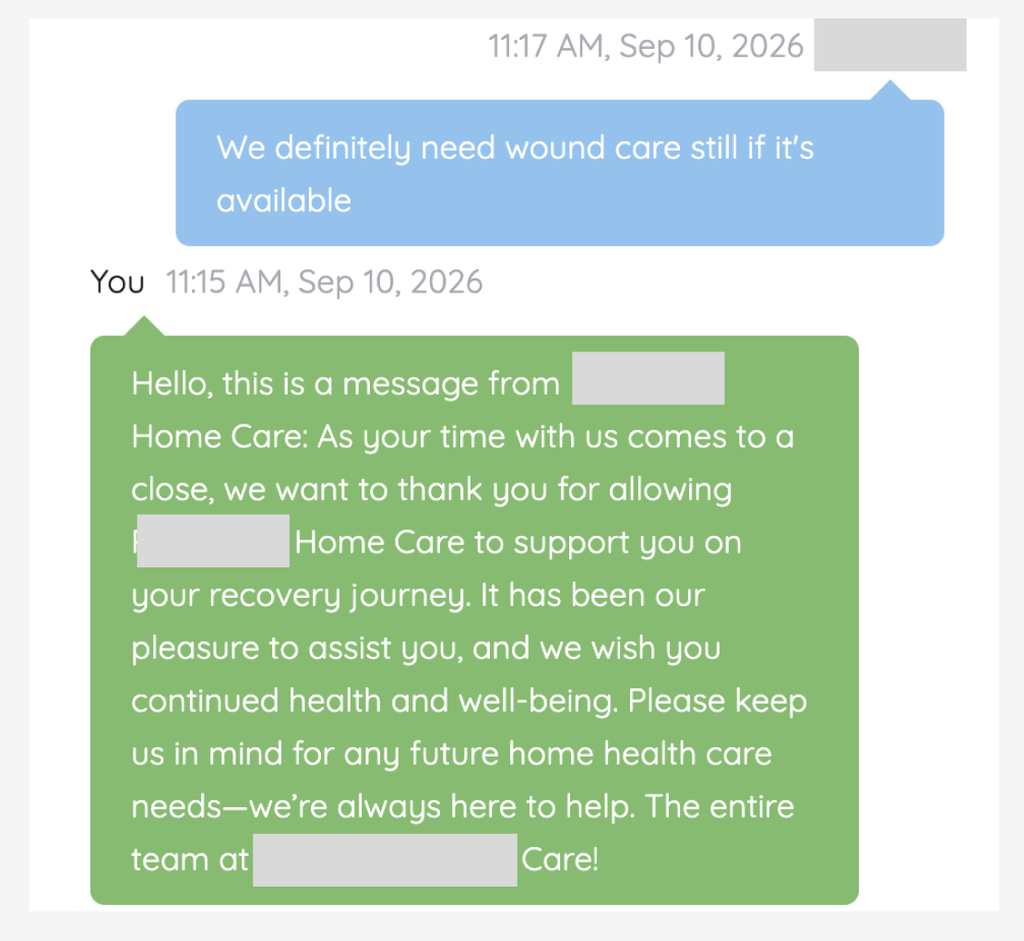
  • They replied that day, asking for help with wound care.
image 7

What the agency experienced

  • Visit Bridge sent an automated email to the Clinical Manager notifying them of a new patient message.
  • The Clinical Manager clicked the direct link, reviewed the message, and called the patient.
  • She coordinated a new Start of Care for 9/12 — two days after the patient reached out.

The math

  • Late, Community, Wound, Medium functional impairment, no comorbidity adjustment (HIPPS 3CB11)
  • Case-mix weight: 1.0848
  • CY 2026 national standardized 30-day base rate: $2,038.22
  • Unadjusted 30-day period payment: $2,038.22 × 1.0848 = about $2,211
  • If the same patient also earns a comorbidity adjustment, the same period pays more:
  • Low comorbidity (3CB21), weight 1.1416: about $2,327
  • High comorbidity (3CB31), weight 1.2838: about $2,617
  • For comparison, the other functional levels in the same late/community/wound bucket with no comorbidity: Low function (3CA11) is 1.0048, or about $2,048, and High function (3CC11) is 1.2201, or about $2,487.

ROI on one message: $2,038.22 using the national 30-day standard and assuming the patients length of stay was only 30 days.

The takeaway

Discharged patients don’t call the office when a new problem shows up. They call whoever is easiest to reach — a doctor, an ER, or another agency. Automated post-discharge engagement keeps your agency at the top of the list, so when the patient needs care again, the text thread is already open and the admission comes back to you.

How Automated Patient Engagement Turned a Great Care Experience Into HHCAHPS Feedback and a Google Review

Positive patient feedback is worth a lot to a home health agency in star ratings, referrals, and staff morale. The problem is that most of it never gets captured. Here’s a real example of how automated engagement did the capturing without anyone on the team lifting a finger.

The situation

  • The agency was struggling to get HHCAHPS surveys returned from patients.
  • An RN completed a Start of Care visit on 8/1.
  • That same day, the patient started receiving automated engagement messages and check-ins from the agency through Visit Bridge Health.
  • On 9/1, 30 days into the initial cert period, the patient became eligible for the HHCAHPS survey and the system automatically sent an educational text about the survey that day.

What the patient did

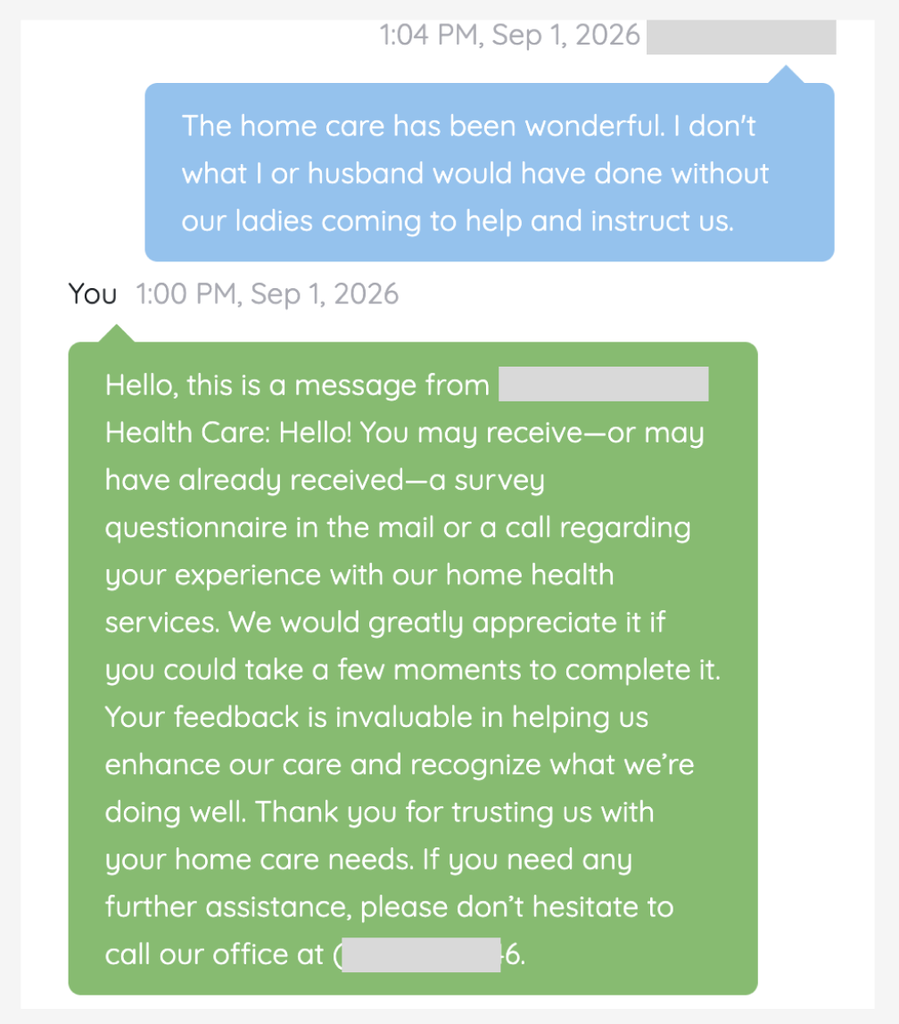
  • Four minutes after receiving the message, the patient replied with a message about their care experience.
image 1

What the agency did

  • Visit Bridge sent an automated email to the Clinical Director notifying them of a new patient message.
  • The Clinical Director clicked the direct link, reviewed the message in Visit Bridge, and identified the “gals” the patient mentioned by name.
  • Those clinicians were recognized at the next all-hands meeting.
  • On 9/2, an automated Google review request went to the patient and her husband, inviting them to share their experience to help others in the community.

The takeaway

Patients who are happy with their care rarely go out of their way to say so. Without a prompt, that feedback stays in the living room. Automated engagement gives patients an easy way to speak up, gives the agency a chance to recognize the clinicians who earned it, and turns a good experience into HHCAHPS responses and public reviews — all without anyone on the team having to remember to ask.

How Automated Patient Engagement Saved a Contracted Therapy Issue (and a $1,857 Episode)

Here’s a real example of what proactive patient engagement looks like in practice.

The situation

  • An RN completed a Start of Care visit on 8/29.
  • The patient needed Physical Therapy, and it was discussed at the SOC visit.
  • The agency ordered a therapy eval through a contracted therapy company.
  • The therapy company assigned a PT — who was slow to reach out.

What the patient did

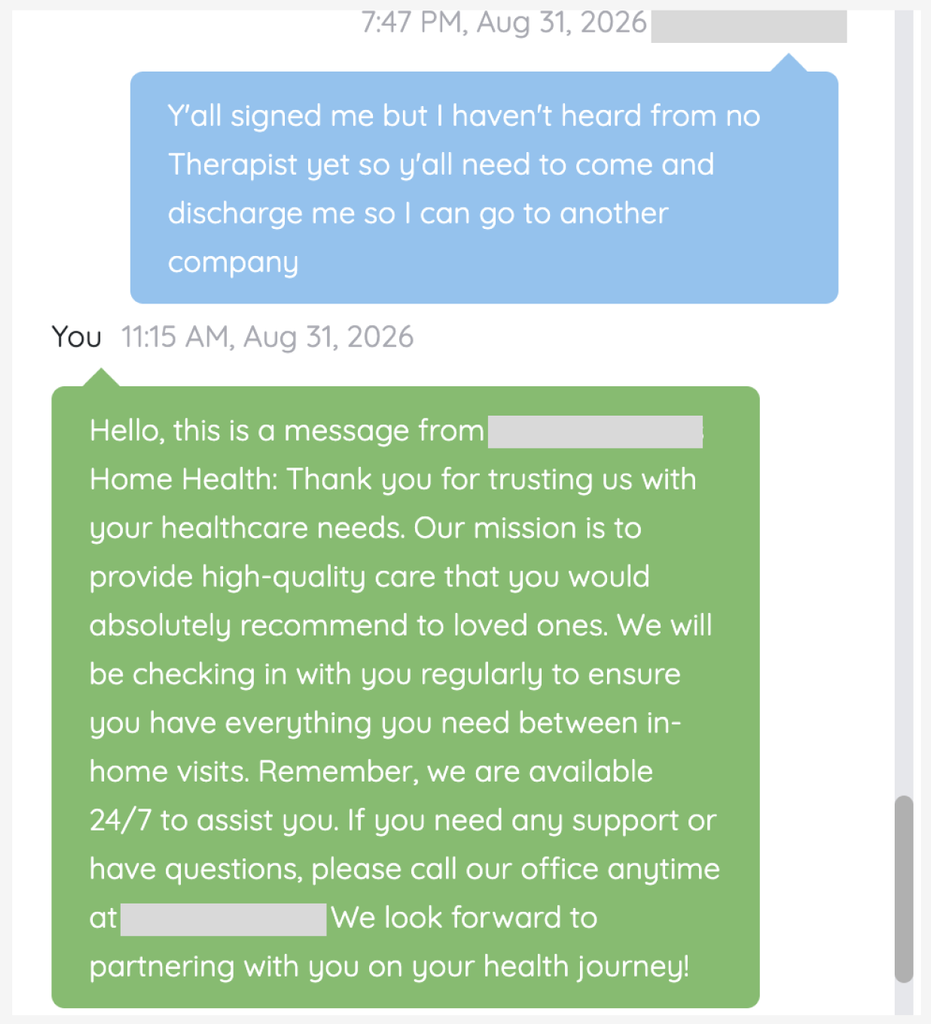
  • The day after admission, the agency’s automated welcome message was sent to the patient at 11:15 AM.
  • Eight hours later, the patient replied. They hadn’t heard from a therapist yet and wanted to be discharged so another agency with therapy could take over.
image

What the agency did

  • The Clinical Manager received an automated email notification about the new patient message.
  • The Clinical Manager clicked the direct link, reviewed the incoming message in Visit Bridge, and called the patient through the platform.
  • They then coordinated with the nurse and the contracted PT company and resolved the issue before anyone showed up at the door.
  • The patient stayed with the agency. No discharge, no lost episode.

The math

  • Medicare average 30-day episode: $2,034
  • Medicare LUPA threshold: 2 visits
  • Visits completed if the patient had discharged: 1 (a LUPA)
  • National average RN LUPA payment: $176.96

ROI on one message: $1,857.04 — and that assumes the patient only stayed 30 days.

The takeaway

Most patients don’t know what to do to be proactive about the care they need. Too often, an agency only catches the problem after a molehill has turned into a mountain. The real power of automated patient engagement isn’t just the content of the message — it’s the window of communication it opens with patients, without anyone lifting a finger.

5 Areas Your Home Health Agency May Want to Review to Enhance User Experience in 2024

By Nora Silver, RN

The Home Health industry can be an overwhelming environment even for industry veterans. The sheer number of laws, rules, regulations, and standards that have to be met often cloud the view of the big picture. As if all the governance was not enough to keep industry leaders up at night, additionally there are STAR ratings, HHVBP, and Surveys that serve as the public report card of agency performance. These concerns are rounded out with financial challenges and staffing crises, creating the turbulent storm many agencies find themselves in.

Over the past 16 months, I’ve been able to step back and truly reflect on my 23 years of experience of living it at the agency level and be a part of building something that solved so many of the challenges our agency faced day in and out.

I’ve found various parallels across the high-performing agencies we work with at Telos Health Solutions, but the more I think about it, the more one universal aspect stands out: providers who set a unified goal around the end-user experience outperform the rest of the pack.

With that said, the end-user experience looks different for the different stakeholders, but there is a common denominator in which I feel all stakeholders desire. So, for owners/operators trying to rally their teams or putting new initiatives into place in 2024, I hope these 6 steps are helpful!

1: Define the Ultimate Goal

The ultimate goal of Home Health can be distilled into one simple idea: prevent unplanned hospital use and keep the patient at home. 

2: Understand Stakeholder Influence

Understanding stakeholder influence is vital to effectively navigate from point A to point B in the most efficient manner. All too often in the home health arena, we as leaders can get caught up in the data points, which can lead us to lose sight of the levers that need to be pushed at the right time to achieve the desired outcome. For example, if we constantly educate our teams on the importance of outcomes from a payer perspective without providing insights or updates on how we, as leaders, are making changes to improve the clinical team’s day-to-day experience to assist them in achieving their set goals, it can often be lost on deaf ears.

3. Manage Risks Effectively

Identify potential obstacles to achieving the goal, including stakeholder engagement, injury prevention, safe medication use, symptom management, early detection of decline, infection control, maintaining functional stability, and ensuring adequate in-home support. Utilize the Medicare Conditions of Participation (CoPs) as a solid foundation for risk management and compliance. CoPs, such as patient rights, comprehensive assessment, and care planning and coordination, address patient-specific readmission risks. Additionally, consider integrating external strategies like virtual patient engagement programs, standardized staff education, and efficient OASIS/Plan of Care and coding practices to enhance success. 

4. Build Momentum by Focusing on Small Wins

As clinicians, we’re typically set in our ways, and many of us abhor change. Combine that with the significant changes that have occurred in the industry over the last five years, and it’s become more challenging than ever to see the impact made through new initiatives. However, sometimes the only way to succeed is to be willing to think outside the box and embrace change. Instead of solely focusing on the end goal, which can often change, I’d recommend finding ways to shift your focus toward achieving small wins. A 1% improvement each day equates to a 36x improvement over the course of a year, so finding ways to set and accomplish small wins can go a long way in the grand scheme of things for a few reasons:

  1. It provides leaders with a means to showcase and praise teams for their accomplishments on a routine basis.
  2. It reduces friction when you need to adjust big-picture goals due to industry or market conditions.

5. Establish a Universal Scoreboard 

Identify success indicators through STAR ratings and HHVBP, which combine OASIS data, claims data, and patient experience data, providing insights on performance from different perspectives. Use these public scores along with others provided by your solution vendors to pinpoint areas of strengths and weaknesses in achieving the ultimate goal of keeping patients at home. Furthermore, a scoreboard serves as a unified reference point for assessing your progress collectively as a team, enabling you to identify and address both technical (software/systems) and non-technical (process/communication) user experience roadblocks.

I truly believe that by focusing on the end-user experience and setting goals that strategically take stakeholder influence into account, home health agencies can navigate these challenges and thrive, ultimately providing better care and support for those who need it most in 2024.

Navigating HCAHPS: From Patient Experience to Financial Success in Home Health Care

In the constantly changing home health landscape, understanding the nuances of the Home Health Care Consumer Assessment of Healthcare Providers and Systems (HCAHPS) scores is crucial for home health agencies. At the heart of this journey lies the differentiation between ‘patient experience’ and ‘patient satisfaction’, two factors that significantly influence the value-based purchasing (VBP) model.

Distinguishing Patient Experience from Patient Satisfaction

As explained by the Agency for Healthcare Quality and Research:

“The terms patient satisfaction and patient experience are often used interchangeably, but they are not the same thing. To assess patient experience, one must find out from patients whether something that should happen in a healthcare setting (such as clear communication with a provider) actually happened or how often it happened.

Satisfaction, on the other hand, is about whether a patient’s expectations about a health encounter were met. Two people who receive the exact same care, but who have different expectations for how that care is supposed to be delivered, can give different satisfaction ratings because of their different expectations.”

Below, we’ve selected a few HCAHPS survey questions to provide perspective on these two distinctions.

Q3: “Were you advised on how to safely organize your home when you began your home health care journey with this agency?”

Q4: “At the onset of your home health care, were you consulted about all the medications you were taking, both prescription and over-the-counter?”

Such questions focus on tangible interactions, spotlighting the patient’s experience. Conversely:

Q20: “On a scale from 0 to 10, where 10 represents the best possible care, how would you rate this agency’s home health providers?”

Q25: “Would you recommend this agency to family or friends seeking home health care?”

These questions aim to gauge the overall emotional response and the satisfaction levels patients have towards their care.

Here is a link to the HHCAHPS survey. Take a look and determine if you agree with our viewpoint that 16 out of the 19 questions, or 84% of the survey questions influencing an agency’s HHVBP scores, prompt patients to recall specific aspects of their home health care experience rather than measure their level of satisfaction.

The Financial Implications with Home Health Value Based-Purchasing (HHVBP)

In 2025, HCAHPS scores may influence up to 30% of the the home health value-based purchasing financial outcome. In the intensely competitive industry, these changes could have profound impacts on agencies Medicare reimbursement adjustments by up to 5%, either positively or negatively.

Implementation Change to Drive Success

Comprehensive Understanding of HCAHPS:  Surveys indicate that while many home health executives understand the importance of HCAHPS, they believe only a few point-of-care clinicians genuinely grasp the HCAHPS survey. It’s vital to ensure your team fully comprehends each question and adjusts care strategies accordingly.

Revised Engagement Paradigms: Aim for patient engagements that are both meaningful and memorable. When patients recall experiences, the likelihood of them answering favorablely significantly increases.

Education & Skill Enhancement:  Emphasizing the significance of HCAHPS scores to your staff is crucial to ensure they understand the substantial impact that patient experience has on the HCAHPS survey questions.

Integrating Proactive Feedback Mechanisms (Weekly calls as an example):  Implementing a continuous feedback system that fosters ongoing patient engagement between in-home visits is essential. This system can involve activities like conducting weekly calls to gather updates, delivering standardized education regarding medication routines, emphasizing the significance of home safety, discussing upcoming schedules, and more. Such proactive measures are instrumental in averting the escalation of minor issues into significant challenges.

Upcoming ACHC Masterclass Webinar: Elevate Your Agency – Mastering HHVBP: Best Practices for Enhancing Quality of Care

For those eager to stay ahead and grasp impending changes, J’non Griffin, RN, SVP of Coding at SimiTree, will present a three-part ACHC masterclass webinar on HHVBP in September.

OASIS, Patient Engagement, and Expanded HHVBP Model – September 14, 2024

Reducing Hospitalizations with Care Management Protocols – September 21, 2024

Improving Patient Case Management to Increase HHCAHPS Scores – September 28, 2023

During the final session on September 28, 2023, Matthew Mulski, Co-founder of Telos Health, will join her to delve into the intricacies of HCAHPS questions and unpack the playbook Telos has used to assist its home health partners in outperforming the national average across all 5 HCAHPS measures, while also achieving a 4.61% hospitalization rate among patients actively engaged in their partners’ home health care navigation program (approximately 70% of patients receiving care from their home health partners as of mid-year 2023).